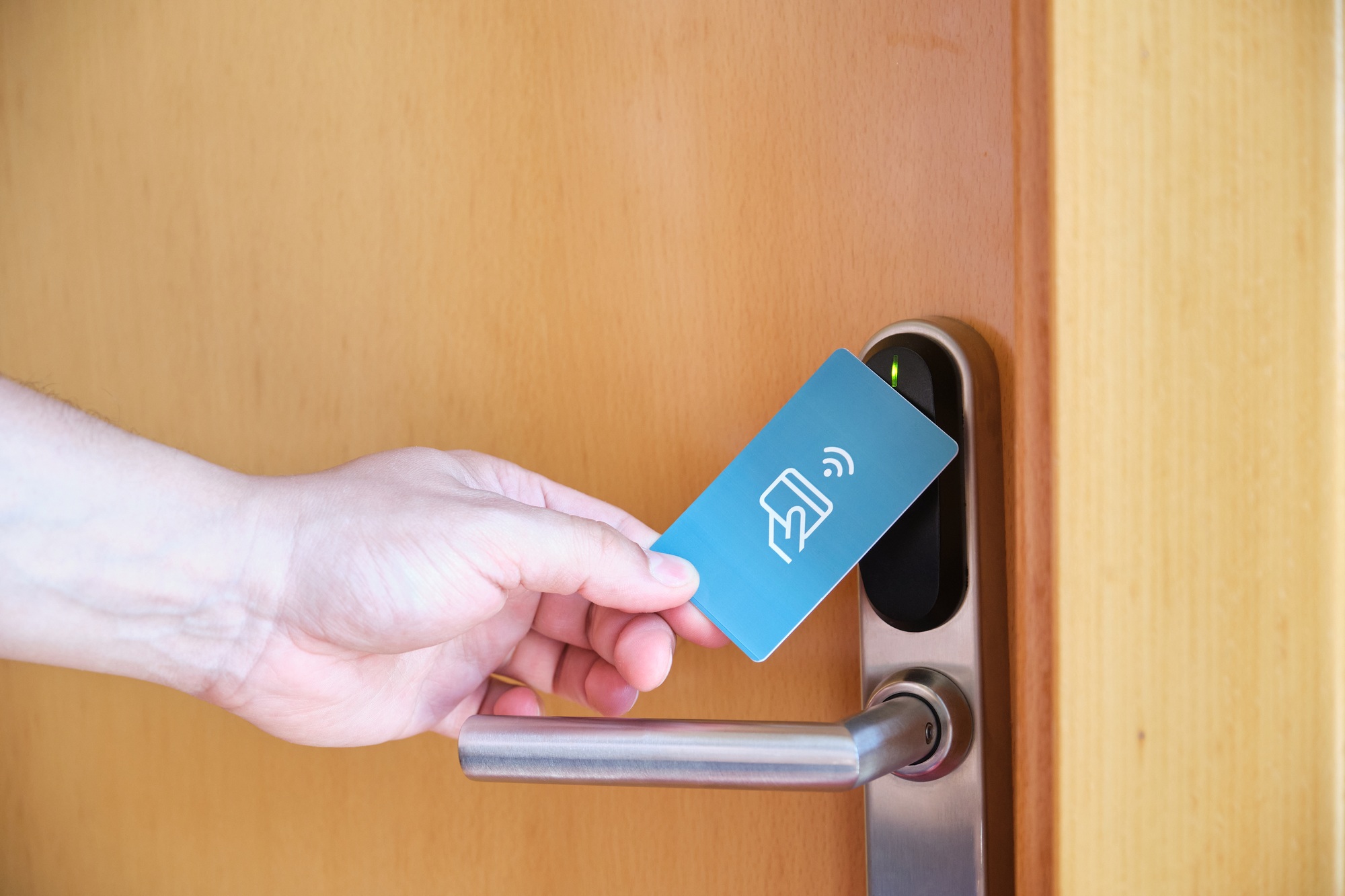
When guests stream Netflix in 4K, unlock rooms with smartphones, and expect touch-free mini-bar billing, the humble cable becomes the unsung hero of hospitality. Hard-wired copper and fibre deliver the bandwidth, uptime, and compliance modern hotels need—far beyond what patchy Wi-Fi alone can guarantee. Below, we unpack how structured cabling ties every piece of hotel inventory together and why Irish operators must design to Building Control Amendment Regulations (BCAR), EU fire-safety rules, and the National Wiring Standard I.S. 10101 to stay legal, insurable, and profitable.
The Expanding Web of “Hotel Inventory”
Today’s “inventory” is more than beds and towels. It includes:
- Smart mini-bars that auto-post charges to the PMS
- IPTV & casting hubs serving personalised content
- IP phones & PoE access points for VoIP and Wi-Fi 6E backhaul
- Data ports for events that demand symmetrical gigabit upload
- Life-safety devices—smoke detectors, EN 54-24 voice-alarm speakers, emergency call points
- Sound-masking & public-address zones for ambience and evacuation
- BMS & IoT sensors monitoring HVAC, lighting, and occupancy
- Energy-storage or EV-charger controllers feeding sustainability reports
Each endpoint must speak to the core network in milliseconds. Structured cabling—Category 6A copper within rooms and OM4/OS2 fibre in risers—offers predictable latency and PoE power budgets that Wi-Fi meshes simply cannot match at scale.
Why Cables Still Beat Wireless for Critical Services
| Challenge | Fibre/Copper Advantage | Wireless Limitation |
|---|---|---|
| Latency-sensitive billing (mini-bars, POS) | Sub-millisecond round-trip; no RF contention | Variable 10–100 ms latency spikes |
| High-density IPTV | 10 Gb + per trunk, multicast support | Airtime saturation above 50+ streams |
| Life-safety audio (EN 54-24) | Shielded balanced lines; survives interference | Susceptible to jamming, DFS channel change |
| Regulatory traceability | Fixed pathways simplify BCAR compliance sign-off | Harder to certify invisible RF paths |
Hard-wired links also simplify cybersecurity: every port can be authenticated, segmented, and monitored, reducing lateral-movement risk if one IoT device is compromised.
Irish & EU Compliance—The Non-Negotiables
3.1 Building Control Amendment Regulations (BCAR)
Since 1 July 2021, BCAR requires electronic lodgement of plans plus a Fire Safety Certificate demonstrating Part B compliance before works start. Structured cabling is central to that certificate: inspectors verify that data, power, and life-safety circuits are segregated, fire-stopped, and labelled in line with the submitted inspection plan.
3.2 National Wiring Rules I.S. 10101:2020 (Amended 2024)
Ireland’s wiring standard now governs voltages up to 1 kV AC across every premises type—hotel bedrooms included. The 2024 amendment—mandatory for contractors by March 2025—explicitly references:
- Allowance for remote-powered devices (PoE)
- Additional bonding for metallic data racks near bathrooms
- Guidance on EV-charger circuits that may share containment with fibre risers
3.3 EU Construction Products Regulation (CPR)
Under CPR, data cables must carry a Euroclass fire rating. Hotels, due to high occupancy, often move from the baseline Dca to B2ca low-smoke, zero-halogen cable.
3.4 EN 54 for Voice Alarm & Detection
EN 54-24 defines loudspeaker performance and test criteria for evacuation messaging, binding in Ireland through Building Regulations Part B. Copper or fibre speaker loops must survive 30–120 minutes of flame exposure, driving the need for fire-resistant cable, ceramic terminal blocks, and protected containment.
3.5 EN 50173-6 Cabling for Distributed Building Services
The 2018 edition codifies balanced and optical-fibre topologies for mixed building services—including HVAC, security, AV, and guest-service networks—providing designers a blueprint for converged hotel cabling.
Topology: Designing a Hotel-Grade Structured Network
- Vertical Backbone (Risers)
12- or 24-core OS2 single-mode fibre to each telecoms room supports 40 Gb uplinks and future GPON overlays. - Horizontal Cabling
Category 6A shielded copper from floor distributors to every room runs at 10 Gb for 100 m, powers IP phones, APs, and mini-bars via PoE++ (90 W). - Zone Cabling
For public areas, bring fibre to ceiling box “mini-MDFs”; convert to PoE copper for cameras, signage, and point-of-sale. - Life-Safety Loops
Use red‐sheath B2ca-s1,d0,a1 data/PA cable in 2-hour rated trunking; terminate in fire-rated racks outside the fire compartment. - Management & Monitoring
SNMP, syslog, and NetFlow on every switch port allow real-time conformance reporting for BCAR inspections and insurer audits.
Performance Gains Across Hotel Inventory
| Hotel Asset | Benefit of Structured Cabling |
|---|---|
| Mini-bar Controllers | Instant restock alerts; no missed charges |
| IPTV & Casting | 4K HDR without buffering or RF congestion |
| IP Phones | Guaranteed QoS for emergency calls |
| Data Ports in Conference Suites | Symmetrical gigabit for live-streaming events |
| Smoke & Voice Alarm Devices | EN 54-compliant audio plus status telemetry |
| Sound Masking | Precise SPL control over shielded twisted pairs |
| Emergency Panels | Single-mode fibre to refuge points for redundant comms |
Future-Proofing: What Today’s Cabling Must Handle Tomorrow
- Wi-Fi 7 Backhaul – 320 MHz channels need >10 Gb uplinks.
- IoT Explosion – Predict 200+ IP addresses per room by 2030 (beds, blinds, bathroom mirrors).
- Edge AI Cameras – 4K/60 fps feeds at 25 Mb/s each—multiplied by hundreds.
- Micro-Data-Centre Rooms – Hotels may host local CDN nodes; fibre risers already in place simplify adds.
- Net Zero Reporting – Real-time metering over Modbus-TCP and BACnet/IP requires deterministic cabling.
Because copper pathways are only 40–50 % full in a well-designed system, upgrades seldom need disruptive re-cabling—just new terminations and optics.
Cost & ROI
While a B2ca-rated Category 6A cable can cost 15–20 % more than non-compliant variants, its share of total project CAPEX rarely exceeds 3 %. Compare that with the revenue risk of a single fire-safety non-conformance or a three-hour network outage that knocks out IPTV, POS, and key-cards. Structured cabling routinely pays back in:
- RevPAR Uplift – Room tech boosts guest-satisfaction scores and upsells.
- Energy Savings – PoE-powered IoT delivers 15–20 % utility reduction.
- Insurance Premium Reductions – Underwriters reward EN 54 and CPR compliance.
- Lower FM Call-outs – Remote monitoring pinpoints faults before guests notice.
Implementation Checklist for Hotel Developers
| Phase | Key Actions | Standards to Reference |
|---|---|---|
| Concept | Engage BCAR Assigned Certifier; map fire compartments | BCAR 2021, Part B |
| Design | Draft single-line diagrams, cabinet locations, containment spec | EN 50173-6, I.S. 10101 |
| Tender | Specify Euroclass B2ca cables; insist on EN 54-24 speakers | CPR, EN 54 |
| Construction | Verify cable labels, pull tensions, bend radii; record as-builts | I.S. 10101 inspection plan |
| Commissioning | OTDR test fibre, certify copper to Class FA, run voice-alarm loop tests | EN 50173-6 conformance |
| Handover | Submit digital O&M manuals to BCMS; lodge Fire Safety Certificate | BCAR Article 13 |
Common Pitfalls and How to Avoid Them
- Mixing Cable Classes – A single run of Eca cable in a riser can void BCAR sign-off; enforce colour-coding and supplier batch sheets.
- Under-specced Pathways – Design 30 % spare tray and riser capacity from day one.
- Forgotten Earthing – Shielded copper needs bonding back to the comms room bar or transient faults will spike IP phones.
- Wi-Fi-Only Mindset – Relying on wireless for life-safety or POS invites latency, interference, and audit-headaches.
- Incomplete Documentation – BCMS submissions lacking as-built cabling schematics trigger expensive re-inspections.
Conclusion: Hard-Wired Hospitality Wins
Copper and fibre may run behind walls, but they sit front-and-centre in guest satisfaction, staff efficiency, and regulatory compliance. By embracing structured cabling that meets BCAR, EN 54, I.S. 10101, and EU CPR, Irish hoteliers lock in decade-long ROI while sleeping soundly through audits and fire-drills alike. Whether its a renovation, extension or a new build wireless will always play a role for mobility, yet it’s the hard-wired backbone that keeps revenue-critical and life-safety services online—no matter how many devices guests plug-in next season.
References
Government of Ireland. (2021). S.I. No. 229/2021: Building Control (Amendment) Regulations 2021. Irish Statute Book.
National Standards Authority of Ireland. (2024, September 26). Important update: National Rules for Electrical Installations (I.S. 10101:2020 + A1:2024).
National Standards Authority of Ireland. (2024). I.S. 10101:2020 + A1:2024 National Rules for Electrical Installations. NSAI Standards Store.
European Committee for Electrotechnical Standardization. (2018). EN 50173-6:2018: Information technology – Generic cabling systems – Part 6: Distributed building services.
European Committee for Standardization. (2018). EN 54-24:2010 + A1:2018: Fire detection and fire alarm systems – Part 24: Components of voice alarm systems – Loudspeakers.
European Parliament & Council of the European Union. (2011). Regulation (EU) No 305/2011 laying down harmonised conditions for the marketing of construction products (Construction Products Regulation). Official Journal of the European Union.
Anixter. (2019). European standards reference guide.
Fire Industry Association. (n.d.). BS EN 54 series – Fire detection & alarm systems.